
You stir a teaspoon of deep green powder into a glass of water, drink it, and twenty minutes later your stomach is doing something you did not sign up for. Nothing dramatic. Just a heavy, gassy, slightly queasy feeling that leaves you wondering whether you made a mistake.
That moment sends a lot of people searching, and what comes back is a mess. Half the internet calls spirulina a superfood. The other half calls it toxic pond scum.
The honest version sits in between. For most healthy adults spirulina is well tolerated, and the side effects people run into are mild and fixable. But there is a short list of people who genuinely shouldn’t take it, and there is one real risk that has nothing to do with the algae itself. The danger of spirulina is almost always about where it was grown and who tested it.
Here’s what actually happens, who should skip it, and how to buy a tub you can trust.
What spirulina is, and why the safety question is a strange one
Spirulina is a blue green algae, technically a cyanobacterium, grown in warm shallow water and dried into powder or pressed into tablets. People have been eating it for a very long time, and in the US it’s sold as a food and a supplement rather than a drug.
That last part matters more than anything else in this article. Supplements aren’t approved before they go on sale. Nobody inspects the tub on your counter unless the company chose to have it inspected.
So the algae itself is a fairly boring, well studied food. The variable is the pond it came from. If you want the plain version of what spirulina is and what it does, start with our Spirulina 101 guide.
The side effects most people actually get
Almost everything everyday users report is digestive, mild, and temporary.
Stomach upset, gas, and loose stools
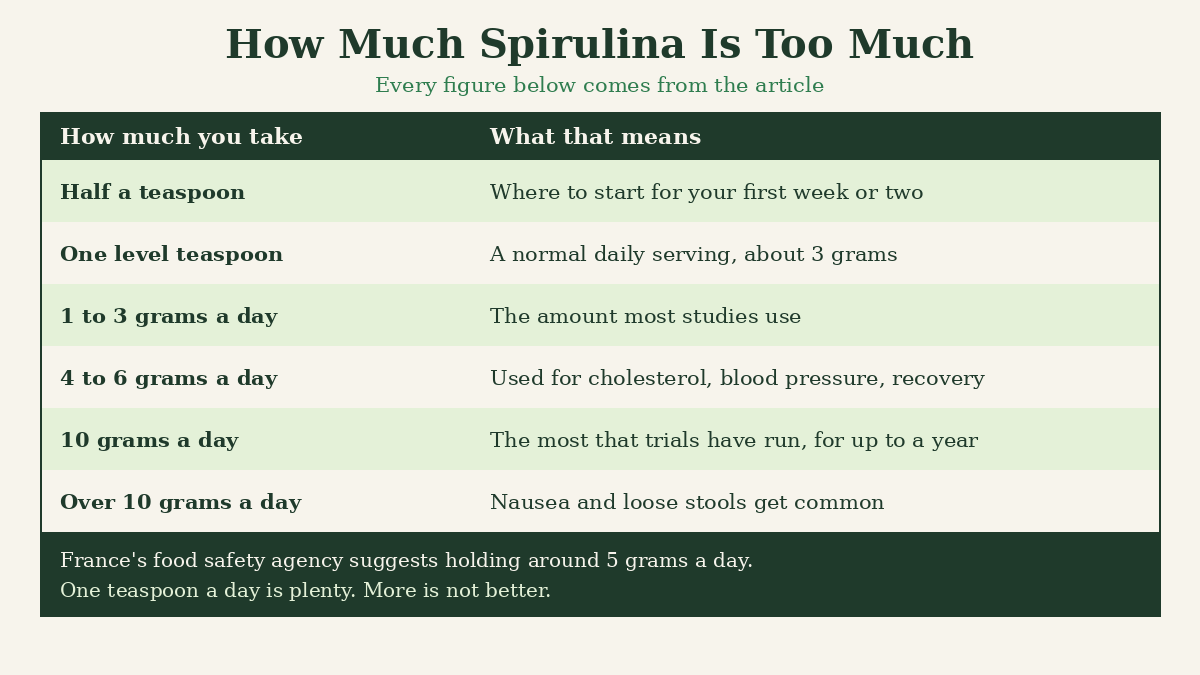
This is the big one, and it’s usually a dose problem rather than a spirulina problem. A heaping tablespoon on day one is a lot of concentrated protein for a gut that has never seen it. Start at half a teaspoon and give yourself a week or two before you move up.
Headaches
Some people get a mild headache in the first few days, and it usually fades. If it doesn’t, that’s a reason to stop rather than push through.
Green everything
Your tongue, your teeth, and yes, your stool can turn a startling green. It looks alarming and it means nothing at all. The pigment simply passes through.
An allergic reaction
Rare, but real. Itching, hives, swelling, or trouble breathing after taking spirulina isn’t a start lower situation, so stop taking it and get medical help right away. If you already react to seafood or seaweed, you have a better reason than most to be cautious.
How much spirulina is too much
Most of the research sits in a narrow band. Studies commonly use around 1 to 3 grams a day, and plenty have run 4 to 6 grams for cholesterol, blood pressure, and exercise recovery. Trials have gone as high as 10 grams a day for up to a year without turning up problems in healthy adults.
For scale, a level teaspoon of powder is roughly 3 grams. A normal daily serving is one teaspoon, give or take.
Past 10 grams the complaints stop being rare. Nausea and loose stools get common, and you’re paying more for a benefit nobody has shown. France’s food safety agency is more conservative still and suggests holding around 5 grams a day.
The practical read: one teaspoon a day is plenty, and more is not better. If protein is why you’re taking it, our guide to spirulina protein explains why a teaspoon contributes less than the marketing suggests.

The real danger of spirulina is what else is in the tub
Here’s the part that deserves your attention.
Microcystins
Spirulina grows in open ponds. Other cyanobacteria would love to grow in those ponds too, and some of them produce microcystins, a group of liver toxins. Clean, well managed spirulina doesn’t make microcystins. A contaminated pond can hand them to you anyway.
Independent testing of algae supplements has repeatedly turned up products over the safety limit for microcystins, with the worst coming in at many times that limit. The pattern in that testing is consistent and useful: the problems cluster in wild harvested pond algae, while controlled spirulina crops come back clean.
Heavy metals
Algae is very good at pulling minerals out of water, which is wonderful when the water is clean and a problem when it isn’t. Lead, cadmium, mercury, and arsenic can all build up. Properly grown and tested spirulina comes back well under limits. A cheap tub from an unnamed source is a coin flip. Researchers reviewing what actually turns up in these supplements land on the same conclusion, that quality control is the deciding factor.
When people talk about the danger of spirulina, this is what they should mean. It’s a sourcing question, and it’s a solvable one.
Who should skip spirulina entirely
Some of these are absolutes and some are conversations to have with your doctor. Both are worth taking seriously.
Anyone with phenylketonuria
Spirulina is packed with protein, and that protein contains phenylalanine. If you have PKU your body can’t clear it. This isn’t a dose discussion, so skip it completely.
People with autoimmune conditions
Spirulina appears to nudge the immune system toward more activity. That’s fine when your immune system is behaving and potentially unhelpful when it’s already attacking you. If you live with lupus, rheumatoid arthritis, multiple sclerosis, or something similar, or you take immunosuppressant medication, ask your doctor before you start.
Anyone on blood thinners
Spirulina carries vitamin K, and vitamin K is exactly what warfarin works against. A new daily dose can throw off a carefully calibrated prescription. Your prescriber needs to know.
People with gout or a history of kidney stones
Spirulina is relatively high in purines, which break down into uric acid. For most people that’s a non issue at food amounts. If you already manage gout or recurring stones, keep the serving modest and talk to your clinician first.
Pregnant and nursing parents
There isn’t enough good safety data here, and the contamination question raises the stakes. Most guidance lands on skipping it or clearing it with a professional first.
Children
Same reasoning. Small bodies, thin data, and a product nobody inspects. Ask a pediatrician rather than guessing.
How to buy spirulina you can trust
The fix for nearly everything above is boring and it works.
Look for a brand that publishes third party test results, sometimes called a certificate of analysis, covering microcystins and heavy metals. A company that tests is a company that will happily tell you it tests.
Prefer spirulina grown in a controlled pond or a closed system over anything sold as wild harvested. On a tub of algae, wild harvested is a marketing word, not a quality one.
Check that the ingredient list reads spirulina and nothing else, or spirulina plus a single binder if you’re buying pressed pills. Our comparison of spirulina tablets and powder covers what else tends to sneak in.
Then look at the harvest or expiry date. Old spirulina tastes worse, and taste is what most people quit over anyway. If yours is unpleasant, our guide to what spirulina tastes like has fixes.
Common mistakes to avoid
A real example, because this is how it usually goes sideways. Someone starts a green routine on a Monday, puts a heaping tablespoon into plain water on an empty stomach, feels awful by lunch, and concludes spirulina is bad for her. She took roughly three times a normal serving, in the least pleasant format, at the worst moment of the day. Half a teaspoon stirred into a smoothie after breakfast would have been completely unremarkable.
The mistakes worth avoiding:
- Starting at a full tablespoon instead of half a teaspoon
- Taking it on an empty stomach during the first week
- Buying the cheapest tub with no country of origin and no testing
- Assuming more is better and creeping past 10 grams a day
- Adding it while on warfarin or an immunosuppressant without telling your prescriber
- Treating a new hive or a swollen lip as something to push through
If taste is your sticking point rather than dose, spirulina drinks are a gentler entry than powder in a glass of water.
Key takeaways
- Most healthy adults tolerate spirulina well at about one teaspoon, or 3 grams, a day.
- Typical side effects are digestive, mild, and usually solved by starting lower and going slower.
- The genuine risk is contamination with microcystins or heavy metals, which comes from the growing conditions rather than the algae.
- Buy from a brand that publishes third party testing, and pass on anything sold as wild harvested.
- Anyone with PKU should avoid it entirely. Autoimmune conditions, blood thinners, gout, pregnancy, nursing, and childhood all call for a professional’s input first.
Questions people ask
Is there any real danger of spirulina for a healthy adult
For a healthy adult taking a tested product at a normal serving, the risk is low. Nearly all documented harm traces back to contaminated or wild harvested algae rather than to spirulina itself.
Can spirulina damage your liver
Liver injury linked to spirulina is rare and usually involves multi ingredient products or contaminated algae. Microcystins are liver toxins, which is the whole reason testing matters.
Why does spirulina upset my stomach
Usually dose and timing. Cut the amount in half, take it with food, and build back up over two weeks.
Is spirulina or chlorella safer
Neither has a clear safety edge. Both grow in water and carry the same contamination question, so testing matters more than the species. Our spirulina and chlorella comparison covers the differences that actually change what you buy.
Does organic spirulina mean it’s clean
Not by itself. Organic certification addresses inputs, not cyanotoxins or heavy metals. Ask for the test results.
This article is general information and not medical advice. If you have a health condition, take medication, or are pregnant or nursing, check with a qualified healthcare professional before adding spirulina or any supplement to your routine.