
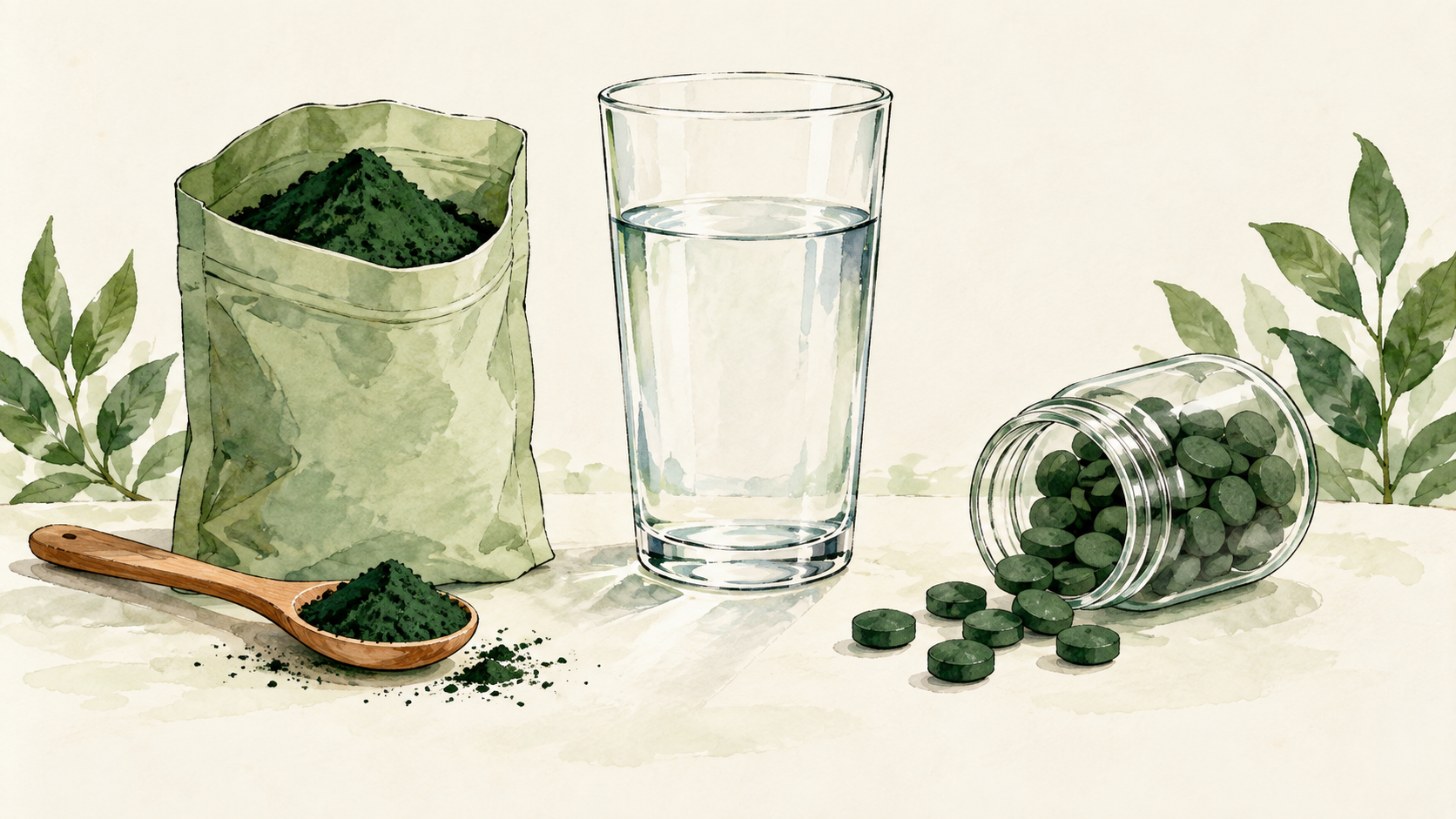
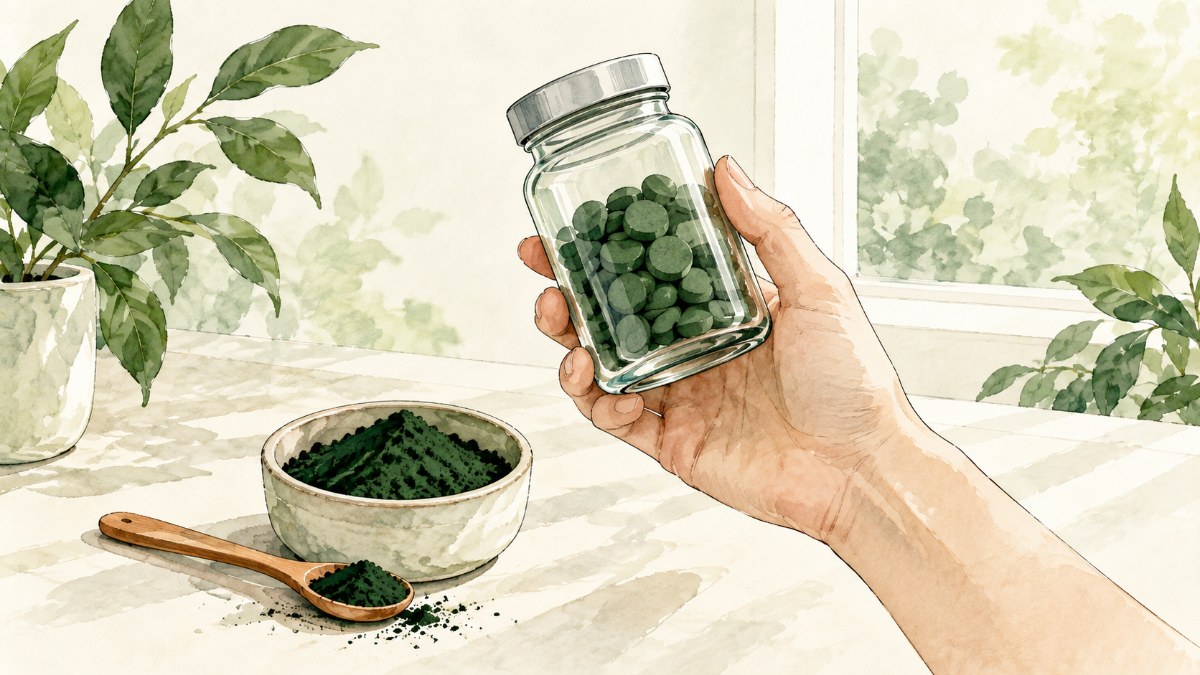
Two listings, same brand, same organic spirulina. One’s a soft green pouch of powder. The other’s a jar of small dark green pills. The pouch costs less, the jar costs more, and neither product page really tells you why you’d pick one over the other.
Most people give up right there and buy whichever one has more reviews.
Here’s the part that clears it up. Both products started as the same crop, grown in the same tanks and dried the same way. The pills are that powder, pressed. You’re not choosing between two nutrition profiles, you’re choosing between two delivery systems, and the right one depends almost entirely on how you actually eat.
So the useful question isn’t which form is stronger. It’s which one you’ll still be taking in a month.
What a spirulina tablet actually is
A tablet is dried spirulina powder squeezed into a shape you can swallow. Nothing gets extracted, concentrated, or improved along the way.
Most of what you’ll find on the shelf is 500 mg per tablet, though 250 mg and 1,000 mg versions exist too. That number matters far more than it looks, and we’ll get to why shortly.
How the powder holds its shape varies by brand. Some presses rely on spirulina’s own proteins, which turn sticky enough under pressure to bind a tablet with nothing else added. Other manufacturers blend in a binder, a flow agent, or a lubricant like magnesium stearate so the powder moves through the machine cleanly.
Neither approach makes a product bad. It does mean the pressed form is the one place you can end up with something besides algae in the jar, so the ingredient list is worth thirty seconds of your attention.
The part that doesn’t change
The nutrition is identical. That’s the answer nobody selling either one wants to lead with.
Both forms come from the same harvested, dried algae. Dried spirulina runs roughly 55 to 70 percent protein by dry weight, and it brings along iron, copper, B vitamins, and the deep blue pigment phycocyanin no matter what shape you buy it in. Pressing powder into a pill doesn’t add anything and doesn’t cook anything off.
Gram for gram, they are the same food. Anyone claiming pills are more potent, or that loose powder absorbs better, is trying to sell you one of them.
The one small edge the pressed form has is storage. A pouch of powder sits open to the air every time you scoop, and air and light slowly dull any plant pigment. A sealed jar is more protected. It’s a real difference, just a modest one, and you cancel most of it out by keeping your pouch sealed in a cool dark cupboard.
If you’re still working out what this stuff is in the first place, start with our plain guide to spirulina and come back.
How many spirulina tablets make a serving
Here’s where the math quietly trips everybody up.
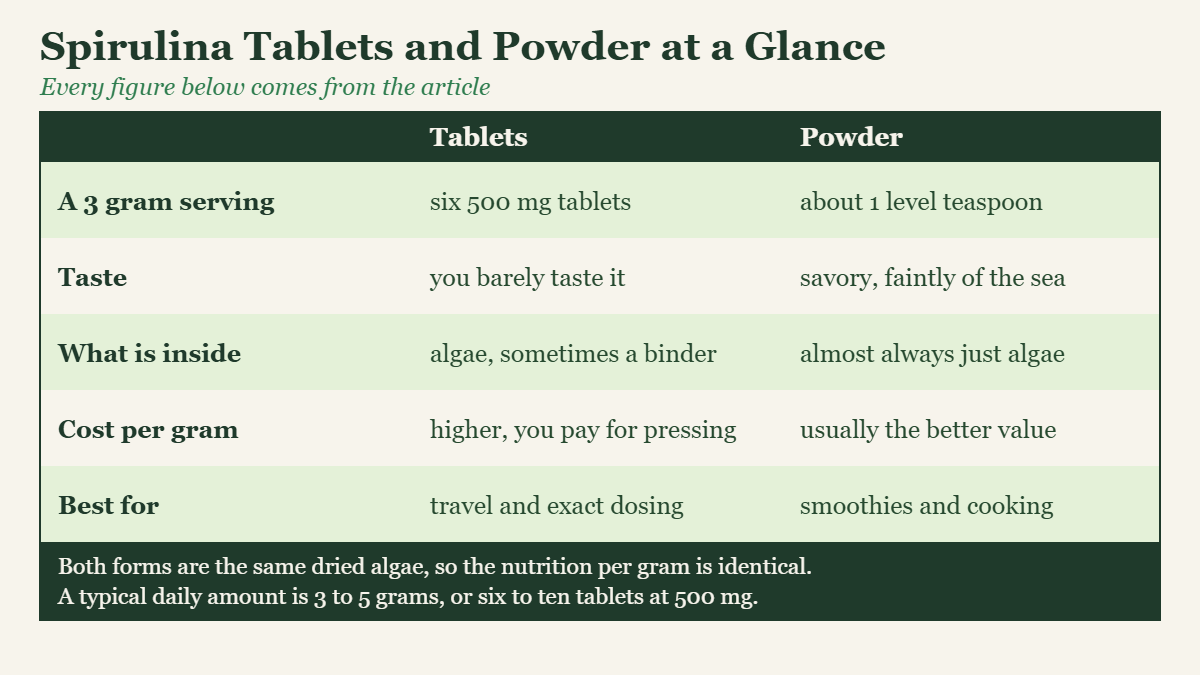
Most research on spirulina uses daily amounts somewhere in the range of 3 to 5 grams. In powder that’s about a level teaspoon, which looks like almost nothing in the bottom of a glass.
In pressed form, that same 3 grams is six 500 mg tablets. If your jar holds 250 mg tablets, you’re taking twelve. One tablet a day is a rounding error, not a serving.
That’s the sticker shock nobody warns you about. A jar of 100 tablets sounds generous until you divide it out and land at about sixteen days. The same money in powder often buys two or three months.
It also explains a lot of the one star reviews. Somebody takes a single pill a day for a month, feels nothing at all, and writes the whole thing off. They were taking roughly a sixth of a normal amount.
Where spirulina tablets are the better buy
Taste is the honest answer, and it’s a good enough reason on its own. Green spirulina tastes savory and faintly of the sea. Some people don’t mind it at all. Others give up in week two and the pouch goes behind the flour for a year.
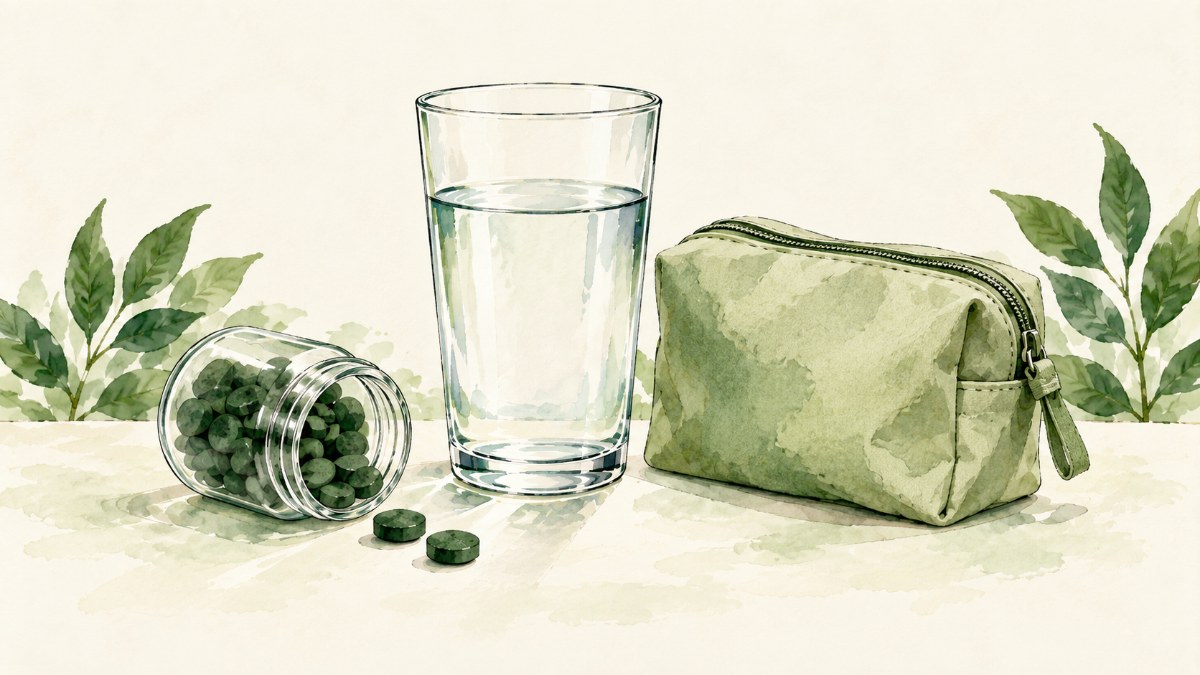
Pills skip the tasting entirely. Water, swallow, done. If flavor is the thing standing between you and a daily habit, that’s the whole ballgame. Our guide to what spirulina actually tastes like covers the workarounds if you’d rather fight for the powder.
They also travel well. A jar goes in a bag without dusting the inside of it green, and there’s no scoop, no blender, and no cleanup in a hotel room.
And they count themselves. Six is six, every single time, in a way that “a heaping teaspoon” never quite is. If you like knowing exactly what you took, that precision is worth paying a little for.
Where the powder wins
Cost, first and most obviously. Pressing is an extra manufacturing step and you pay for it. Compare the price per gram, not the price per container, and the gap is usually hard to miss.
Powder also scales without effort. Going from 3 grams to 5 means a slightly fuller spoon rather than four more things to swallow.
Then there’s everything you can do with it. Powder goes into smoothies, shakes, lemonade, energy balls, salad dressing, guacamole, and cold soups. A pill does exactly one thing. If you like cooking, that flexibility is the real argument, and our easy spirulina drinks and simple spirulina recipes are a decent place to see what that looks like day to day.
Powder is also nearly always just spirulina and nothing else. No binder, no flow agent, no coating. When a short ingredient list matters to you, that’s the easiest way to get one.
What to check on the label before you buy
Whichever form you land on, the same three checks decide whether it’s worth your money.
Third party testing
Spirulina absorbs what it grows in. Crops raised in poorly controlled open water can pick up heavy metals or microcystins, which are toxins produced by other algae that sometimes share the water. Buy from a brand that publishes third party test results, and skip anyone who won’t tell you where their algae was grown. The National Center for Complementary and Integrative Health makes the same point about blue green algae supplements generally.
The ingredient list
On a powder you want to see one line. On a pressed product you might see a binder or magnesium stearate, and plenty of perfectly good brands include them. What you don’t want is a long list, added color, or a proprietary blend that hides how much algae you’re actually getting.
The size and the count
Do the division in the store. Tablet weight times the count, divided by the grams you plan to take, tells you how many days the jar lasts. A 250 mg product with 300 pills sounds enormous and is actually about three weeks.
A real year with both
A regular at our farm stand bought a pouch of powder last January because it was clearly the better deal. She used it twice, decided it tasted like the bottom of a pond, and put it behind the flour.
In March she tried spirulina tablets instead. She takes six with her coffee, has never once thought about the flavor, and hasn’t missed a week since.
On paper she made the worse purchase twice over. She paid more per gram and she still owns an unopened pouch of the cheaper option. In practice she’s the only version of herself who’s getting any spirulina at all. The cheapest supplement is the one you never take, and it’s worth exactly nothing.
Common mistakes to avoid
- Taking one pill and calling it a serving. Read the label, do the math, and take the number that actually adds up to a few grams.
- Comparing the price on the front of the jar instead of the price per gram inside it. Container sizes are wildly different between the two forms.
- Starting at a full dose. Begin with about half a teaspoon of powder, or two pills, for a week or so. Jumping straight in can leave you gassy or running to the bathroom.
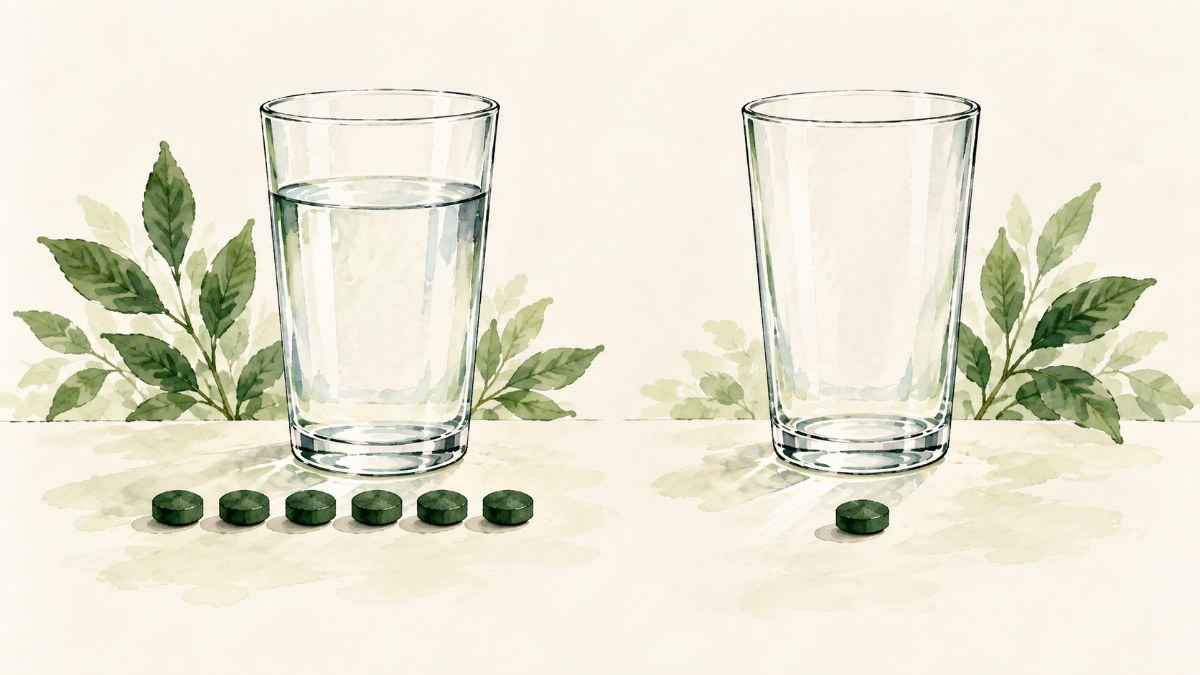
- Swallowing pressed algae dry. They’re dense, and they go down much easier with a full glass of water.
- Keeping powder on the counter beside the stove. Heat, light, and steam are the three things that fade it fastest. A cool dark cupboard, sealed, is all it needs.
- Counting on either form for vitamin B12. Spirulina carries a version your body can’t reliably use, so it isn’t a substitute if you need B12.
Key takeaways
- Both forms are the same dried algae, so the nutrition doesn’t change. Only the packaging does.
- A typical daily amount is 3 to 5 grams, which is about a level teaspoon of powder or six 500 mg pills.
- Pressed algae wins on taste, travel, and exact dosing. Powder wins on cost, flexibility, and a shorter ingredient list.
- Check for third party testing and a named growing region before you check anything else.
- The form you’ll take every day beats the form that looked smarter at checkout.
Frequently asked questions
Are spirulina tablets as good as the powder?
Yes, assuming you take an equivalent amount. They’re made from the same dried algae, so the nutrition per gram matches. The differences are cost, taste, and how easy each one is to fit into your day.
How many should I take a day?
Most people land at 3 to 5 grams daily, which is six to ten pills at 500 mg each. Start lower, around two, and work up over a week or two so your stomach has time to adjust.
Do they contain fillers?
Some do and some don’t. Certain brands press the powder cold with nothing added, relying on spirulina’s own proteins to bind. Others use a small amount of binder or magnesium stearate. Check the ingredient list if it matters to you.
Are capsules better than spirulina tablets?
Capsules hold loose powder in a shell instead of compressing it, so they’re gentler on the stomach for some people and easier to swallow. They usually hold less algae each, which means a higher count and a higher price for the same grams.
What about chlorella instead?
Different algae, different strengths. We broke down how spirulina and chlorella compare if you’re weighing the two.
This article is general information and is not medical advice. Spirulina is not right for everyone. People with phenylketonuria, autoimmune conditions, or bleeding disorders, and anyone taking blood thinners or immune suppressing medication, should be especially careful. If you have a health condition, take medication, or are pregnant or nursing, please check with a qualified health professional before adding spirulina in any form.