

Stand in the supplement aisle long enough and you’ll notice two tubs of green powder sitting right next to each other, roughly the same size, roughly the same price, promising roughly the same things. One says spirulina. The other says chlorella. Nothing on either label tells you why you’d pick one over the other.
They aren’t interchangeable, and the difference isn’t marketing. One of them is a bacteria. The other is a plant. That single fact shapes how each one is grown, what’s inside it, how your body handles it, and which one belongs in your glass.
So here’s what actually separates them, in plain terms, plus how to tell which tub is the right one for you.
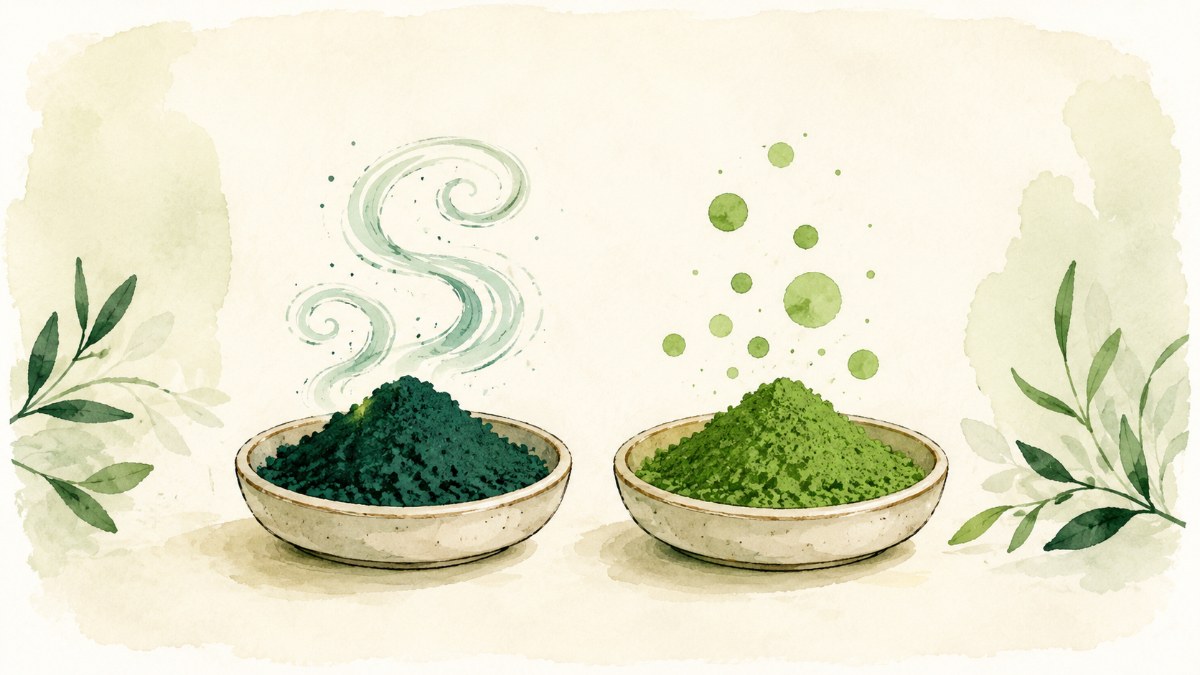
What spirulina and chlorella actually are
Spirulina isn’t algae at all. It’s a cyanobacterium, a type of blue green bacteria that grows in warm, alkaline water. Under a microscope it looks like a tight little spiral, which is exactly where the name comes from.
Chlorella is the real algae of the pair. It’s a single celled green algae that grows in fresh water, round instead of spiraled, and absolutely loaded with chlorophyll. That’s where its name comes from too.
Stores lump both of them together under “green algae powder” and nobody corrects it. But the distinction isn’t trivia. It explains almost every practical difference that follows, starting with the one that decides whether your money is wasted. If you want the longer version on just one of them, our Spirulina 101 guide covers it start to finish.
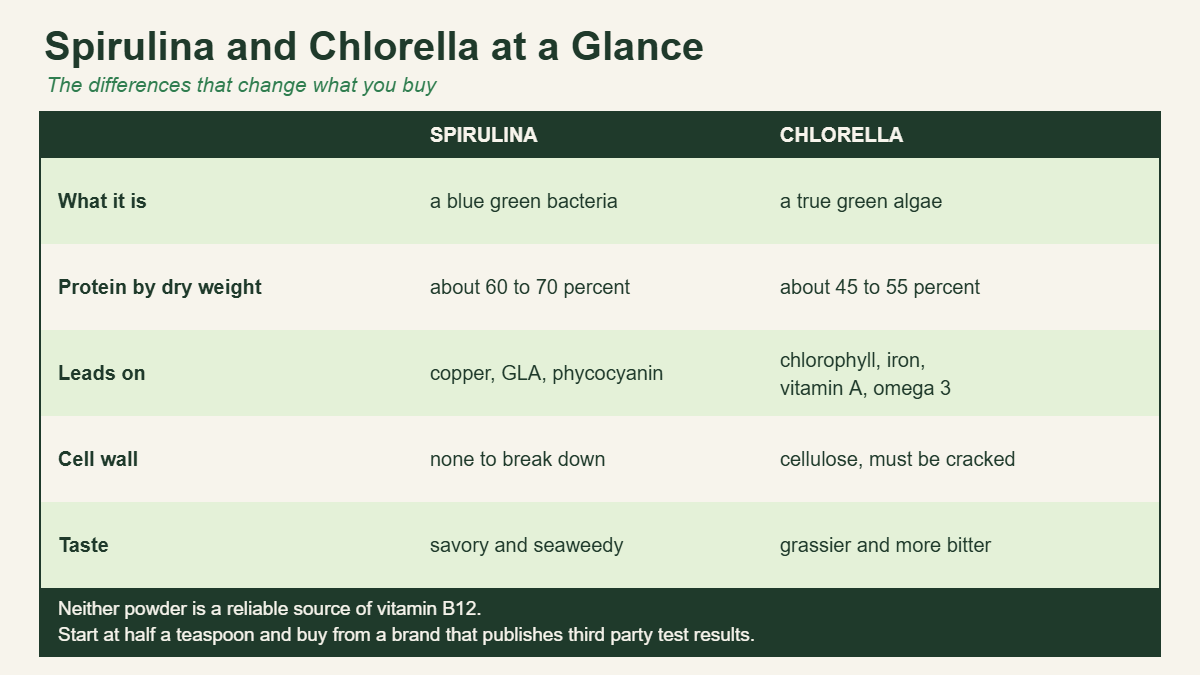
The nutrition differences that actually matter
Both powders are dense. Both are far more nutritious per gram than almost anything else you’ll stir into a drink. They just lean in different directions.
Spirulina is the protein one. By dry weight it runs somewhere around 60 to 70 percent protein, which is a genuinely unusual number for a plant food. Chlorella sits lower, around 45 to 55 percent. Before that sells you on anything, remember the serving size: the protein in one teaspoon is a gram or two, not a meal.
Chlorella pulls ahead on chlorophyll, beta carotene, iron, magnesium, and omega 3 fats. Spirulina pulls ahead on copper, on GLA (an omega 6 fat), and on phycocyanin, the blue pigment that gives spirulina its faint blue undertone and gives blue spirulina powder its whole reason to exist.
One warning worth more than all of that. Neither powder is a dependable source of vitamin B12. Both contain compounds that register as B12 on a lab test but don’t function as B12 inside you. If you eat plant based and you’ve been counting on green powder to cover it, cover it another way. The NIH fact sheet on B12 lays out the sources that do work.
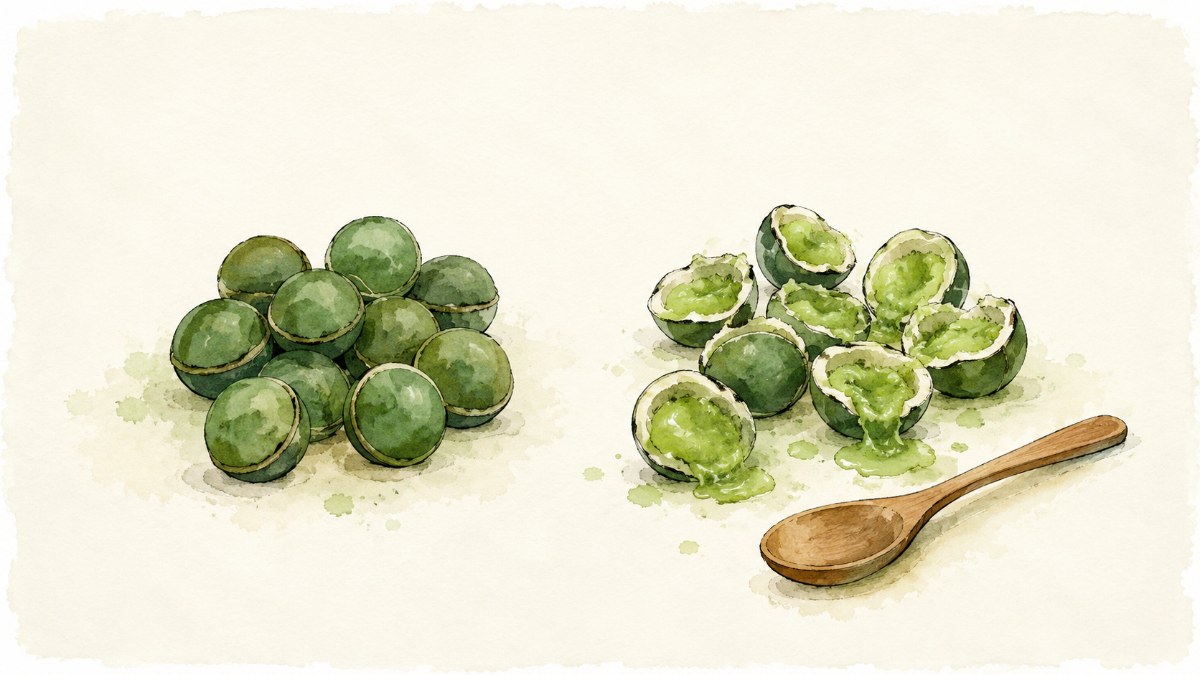
The cell wall difference that changes what you buy
This is the part that costs people money without them realizing it.
Chlorella is wrapped in a tough cellulose cell wall, and humans don’t carry the enzymes to break cellulose down. Left whole, a chlorella cell travels through you sealed shut. So decent chlorella gets mechanically cracked open during processing before it’s ever dried and packed.
Which means when you shop, look for the words broken cell wall or cracked cell wall on the label. If a chlorella tub doesn’t say it anywhere, assume it hasn’t been done, and most of what you paid for is going to pass straight through you. That extra processing step is also the main reason chlorella tends to cost a little more per ounce.
Spirulina skips the problem entirely. Its outer membrane is soft rather than cellulose, so it’s digestible as is, straight out of the dryer. There’s nothing special to hunt for on a spirulina label.
What each one tastes like
Let’s be honest about this, because taste is where most green powder ends up abandoned at the back of a cupboard.
Both taste like the ocean. Spirulina reads savory and a bit seaweedy, almost like a broth. Chlorella is usually the stronger of the two, grassier and more bitter, closer to a mouthful of wet lawn than a mouthful of soup.
Neither one disappears in plain water. What does work is acid and sweetness together: citrus, pineapple, banana, or a spoon of cocoa. If you want specific combinations that hold up, we’ve collected ten low effort ways to use spirulina that work just as well with chlorella.

How to choose between spirulina and chlorella
Pick by what you actually want out of it.
- You’re brand new to green powder. Start with spirulina. It’s usually cheaper, it’s easier to drink, and there’s no cell wall question to get wrong.
- You want the most protein per spoon. Spirulina, comfortably.
- You’re after iron, vitamin A, and chlorophyll, and a stronger flavor doesn’t scare you. Chlorella.
- You want that vivid blue for a smoothie bowl. Only spirulina gets you there, because only spirulina has phycocyanin.
- You take a blood thinner. Chlorella is high in vitamin K, which can work against those medications. Talk to your doctor before you buy either one.
One more thing about choosing between spirulina and chlorella, and it’s the part the labels will never tell you: the better one is whichever you’ll still be drinking in a month. A tub of the theoretically superior powder does nothing sitting unopened.
And a note on the claim you’ll see everywhere. Chlorella gets sold hard as a heavy metal detox. The research behind that is early, mostly small, and nowhere near strong enough to buy a supplement over. Buy chlorella for its iron and its chlorophyll. Treat anything else as a maybe.
A real week with both tubs on the counter
Say you bought both, because that’s what most curious people do.
Monday you stir half a teaspoon of spirulina into a splash of orange juice, work it into a smooth paste with the back of a spoon, then top the glass up with cold water. It’s green, it’s faintly savory, and you finish it without thinking much about it.
Wednesday you try the identical routine with chlorella and it tastes like a lawn clipping. So Thursday it goes into the blender instead, with frozen pineapple, half a banana, and cold water. Buried under that much sweetness and acid, it’s genuinely fine.
By the second week the spirulina lives beside the juice and the chlorella lives beside the blender, and you stopped thinking of it as a decision. That’s usually how this settles.

Common mistakes to avoid
- Starting at a full tablespoon. Both powders can bring gas, bloating, or loose stools in the first week. Begin at half a teaspoon and build up over a couple of weeks.
- Buying chlorella that says nothing about its cell wall. If the label is silent, keep walking.
- Dumping powder into a full glass. It clumps and floats. Make a paste with a splash of liquid first, every time.
- Skipping the testing question. Both are grown in water, and open ponds can pick up heavy metals or, in the case of cyanobacteria, microcystins. Buy from a brand that publishes third party test results.
- Treating either one as a vegetable replacement. A teaspoon of powder is a supplement to real food, not a stand in for a plate of it.
Key takeaways
- Spirulina is a blue green bacteria. Chlorella is a true green algae. Only one of them is technically algae.
- Spirulina carries more protein and the blue phycocyanin pigment. Chlorella carries more chlorophyll, iron, vitamin A, and omega 3.
- Chlorella needs a broken or cracked cell wall to be digestible. Spirulina needs nothing.
- Chlorella usually tastes stronger. Spirulina is the easier first purchase.
- Neither one is a reliable source of vitamin B12, whatever the front of the tub implies.
Frequently asked questions
Can you take spirulina and chlorella together?
Yes, and plenty of blends sell them premixed at roughly half and half. Nothing in one works against the other. If your stomach is sensitive, start with one on its own for a week or two, so you know which powder to blame if something feels off.
How much should you take a day?
A level teaspoon, around 3 grams, is the typical serving on most tubs. Research has used higher amounts, but more isn’t automatically better, and a bigger scoop mostly just makes your drink taste worse.
Which one is better for iron?
Chlorella generally comes out ahead on iron. Pair it with something rich in vitamin C, like the pineapple or citrus you’re probably already blending it with, since vitamin C helps your body absorb plant iron.
Does either one contain caffeine?
No. Any lift people report from spirulina and chlorella comes from nutrition and habit, not from a stimulant.
Which one should you buy if you can only buy one?
Spirulina, for most people. It’s cheaper, milder, and there’s less to get wrong at the shelf. Once it’s a habit, chlorella is a reasonable second tub.
Green powder is a small, cheap upgrade to a drink you’re already making. Neither spirulina nor chlorella is going to transform your health on its own, and anyone telling you otherwise is selling something. Pick the one you’ll actually drink, buy it from someone who tests it, start small, and let it be a habit instead of a project. For a drink that puts it to work immediately, our guide to juicing to fight inflammation is a good next stop.
This article is general information and is not medical advice. If you have a health condition, take medication, or are pregnant or nursing, please check with a qualified healthcare professional before adding spirulina, chlorella, or any new supplement to your routine.