
You’ve probably spotted the word on a tea label, a fancy latte menu, or the side of a supplement jar. Adaptogens. It sounds a little mystical, like something a herbalist would whisper about. But the idea behind it is pretty down to earth, and it’s worth understanding before you spend money on a powder that promises calm in a scoop.
So here’s the plain version. Adaptogens are plants and mushrooms that are said to help your body handle stress and stay in balance. Think of them less as a switch that turns stress off and more as a steadying hand. They tend to work slowly, over weeks, not in a single dramatic dose. If you’ve read our guide to mushroom tea, you’ve already met a couple of them without knowing it.
This is an honest guide, not a sales pitch. We’ll walk through what adaptogens actually are, where the idea came from, how they’re thought to work, the most common ones, and whether the science backs up the buzz. We grow food for a living, so we like our wellness claims grounded.
So what are adaptogens, exactly?
An adaptogen is a herb or mushroom that helps your body adapt to stress without knocking it off balance in one direction or the other. The classic definition has three parts: it should be safe to take at normal amounts, it should help you resist many kinds of stress rather than just one, and it should have a normalizing effect, calming what’s overactive and lifting what’s run down.
That last part is the interesting bit. A cup of coffee pushes you in one direction, up. A sedative pushes you the other way, down. An adaptogen is meant to nudge you back toward the middle, wherever you happen to be. Whether any plant truly does all of that is a fair question, and we’ll get to it.
Where the idea comes from
The word itself is newer than you’d think. A Soviet scientist named Nikolai Lazarev coined the term in 1947 while studying substances that might help people hold up under physical and mental strain. Two decades later, other researchers tightened the definition into the three rules above.
The plants, though, go back thousands of years. Ashwagandha has been used in Ayurveda, the traditional medicine of India, for a very long time. Ginseng anchors a lot of Traditional Chinese Medicine. Rhodiola grew in the cold Siberian mountains and earned a reputation for helping people push through hard conditions. The modern label is recent. The practice is ancient.
How adaptogens are thought to work
Your body has a built in stress system, sometimes called the HPA axis. It runs the loop between your brain and your adrenal glands, and it controls cortisol, your main stress hormone. When life piles up, cortisol climbs. When it stays high for too long, you feel it as poor sleep, low energy, and a short fuse.
Adaptogens are thought to work on this system, helping keep cortisol from swinging too high or dropping too low. The idea is a steadier baseline, so a stressful Tuesday doesn’t wipe you out for three days. It’s a gentle effect, not a rescue remedy. Nobody should expect an adaptogen to erase real stress or replace a good night’s sleep.
The most common adaptogens
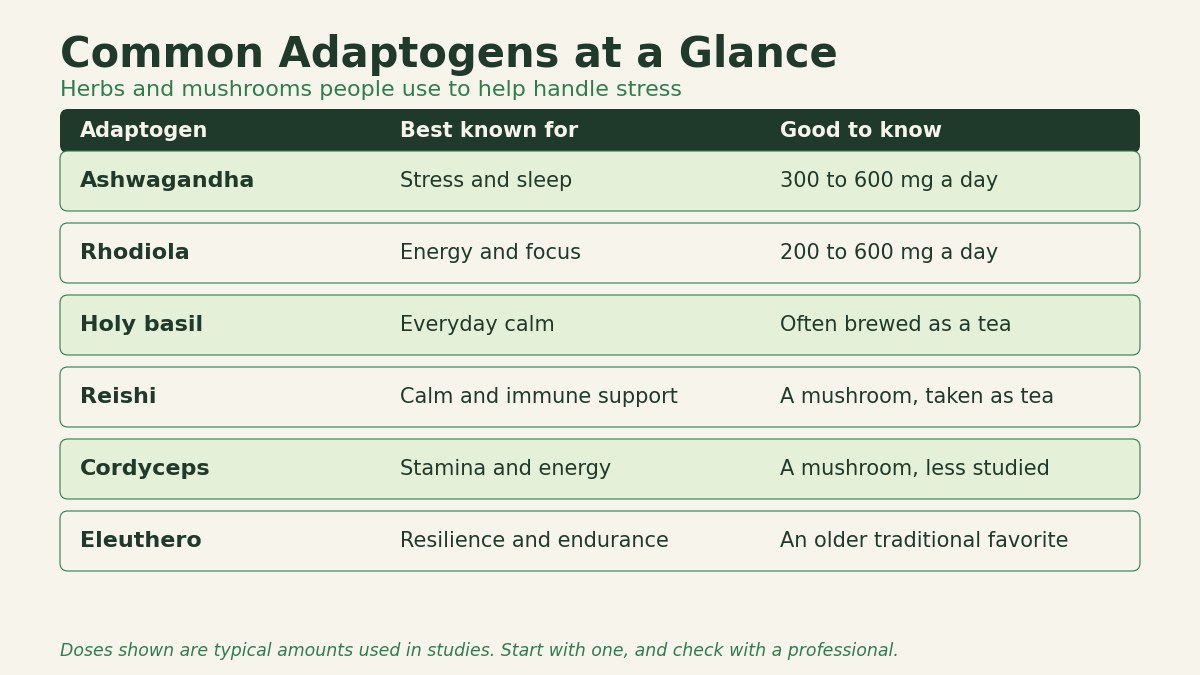
There are a handful you’ll run into again and again. Here’s the short, honest rundown.
- Ashwagandha is the most studied of the group. People take it for stress and sleep, and several studies suggest it can lower cortisol in stressed adults. Typical study doses land around 300 to 600 mg a day.
- Rhodiola leans more toward energy and focus. It has a mild lift to it, so people usually take it in the morning. Study doses often fall between 200 and 600 mg a day.
- Holy basil, also called tulsi, is a calming herb often brewed as a tea. It’s easy to fold into a daily routine and gentle enough to drink with meals.
- Reishi is a mushroom, not a leafy herb. It’s rich in plant compounds called polysaccharides and triterpenes, and people take it for calm and immune support. Our mushroom tea guide covers how to brew it.
- Cordyceps is another mushroom, this one aimed at stamina and energy. Most of the stress research on it comes from animal studies, so keep your expectations reasonable.
- Eleuthero, sometimes called Siberian ginseng, rounds out the list as an older favorite for general resilience and endurance.

Do adaptogens actually work?
Here’s where the honesty matters. Some adaptogens have real research behind them, and ashwagandha is the strongest example. Studies have linked it to lower cortisol and lower reported stress. That’s promising. You can read a plain summary of the ashwagandha research at the National Center for Complementary and Integrative Health.
But the category as a whole is not settled science. “Adaptogen” isn’t an approved medical or marketing term in the United States or the European Union, and the quality of research varies a lot from plant to plant. Many studies are small, short, or funded by the people selling the product.
So the fair take is this. A few of these herbs may genuinely help you handle stress a little better, especially over several weeks. None of them are magic, and they work best alongside the boring basics: sleep, movement, real food, and time outside. If a product promises to melt your stress overnight, that’s a claim to walk away from.
How to actually use adaptogens
If you want to try one, start with a single herb rather than a blend with a dozen ingredients. That way you can tell what’s actually doing something.
Most people take ashwagandha in the evening if they’re after calm and better sleep, and rhodiola in the morning because of its slight energizing effect. Holy basil and reishi both make an easy tea. Give any of them a few weeks before you judge, since the effects build slowly.
A common approach is to cycle: several weeks on, then a short break, rather than taking the same thing forever. And you don’t need a cabinet full of powders. One well chosen herb, used consistently, beats a shelf of half used jars.
Here’s a real example. Say you’re sleeping badly during a stretch of long work weeks. You might try a small evening dose of ashwagandha, keep a steady bedtime, and cut the late night scrolling. After two or three weeks you check in: sleeping better, or no different? If nothing’s changed, you stop. That’s the whole method. Simple, patient, and honest.
Common mistakes to avoid
The biggest one is expecting a fast fix. Adaptogens are slow by nature, so a single dose won’t do much.
Another is stacking five of them at once in a trendy blend, which makes it impossible to know what helped or what caused a headache. Start simple.
People also skip the label and take too much, thinking more is better. It usually isn’t. Stick to the amount on the package or what a professional suggests. And plenty of folks reach for a powder while ignoring the free stuff that works better than any of it: real sleep and a daily walk.
Who should be careful
Adaptogens are generally well tolerated, but they aren’t right for everyone. Mild side effects can include headaches, an upset stomach, or drowsiness.
If you have a thyroid condition, an autoimmune issue, or you take prescription medicine, some adaptogens can interact with what you’re already on. That’s a real concern, not a formality.
This article is general information, not medical advice. Adaptogens can affect hormones and interact with medications, so if you have a health condition, take any medication, or you’re pregnant or nursing, please check with a qualified professional before adding one. Nothing here is meant to diagnose or treat any condition.
Key takeaways
- Adaptogens are herbs and mushrooms said to help your body handle stress and stay balanced.
- They’re thought to work on your cortisol system for a steadier baseline, and they act slowly over weeks.
- Ashwagandha has the most research behind it. Most of the others are promising but less proven.
- Start with one herb, give it a few weeks, and lean on sleep, movement, and real food first.
Frequently asked questions
What are adaptogens in simple terms?
They’re plants and mushrooms, like ashwagandha, rhodiola, and reishi, that are said to help your body cope with stress and stay in balance, working gradually rather than all at once.
Do adaptogens really lower stress?
Some may help a little, and ashwagandha has the best evidence for lowering cortisol and stress. None of them replace sleep, movement, or medical care.
How long do adaptogens take to work?
Usually a few weeks of steady use. Rhodiola can feel quicker, while ashwagandha’s calming effects tend to build over two to three weeks.
Can you take adaptogens every day?
Many people do, though a common approach is to cycle with short breaks. Check with a professional if you take medicine or have a health condition.