
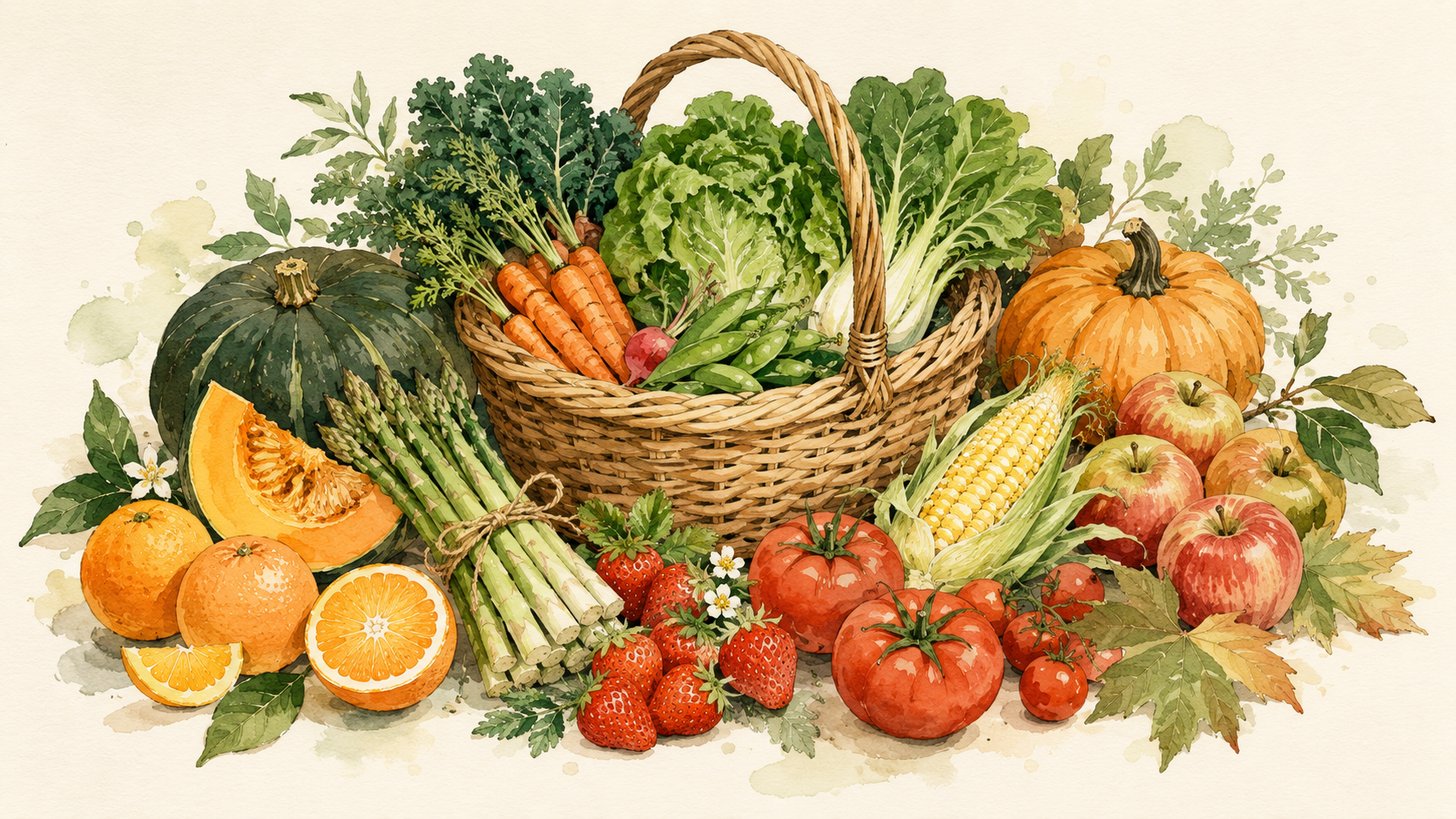
Sometime in January you’ll stand in the produce aisle holding a clamshell of strawberries. They’re big. They’re red. They cost six dollars. You get them home, bite one, and it tastes like cold water with a faint rumor of strawberry in it.
That berry isn’t a farming failure. It got picked hard and pale somewhere far away, rode a truck for days, and showed up in a month when nothing about it wanted to be a strawberry.
Eating with the seasons fixes that, and it’s simpler than the phrase makes it sound. You’re not signing up for a philosophy. You’re buying whatever is at its peak right now, which tends to be the thing that tastes best and costs least anyway. Here’s what’s good each month, why it works, and how to shop it without turning grocery day into homework.
What seasonal eating actually means
Seasonal eating means buying produce during the window when it’s being harvested somewhere near you, instead of when it’s been flown in from the opposite hemisphere. No rulebook, no purity test, no banned list. All a seasonal eating guide really tells you is when each harvest window is open.
Here’s what trips people up. Nearly everything is available all the time now, so “in season” stopped being obvious. The store stocks strawberries in December and asparagus in October. The supply chain is impressive. It just doesn’t tell you whether the food is any good.
One more thing: seasons are local, not national. Tomatoes peak in July across most of the country and stretch deep into October here in the Sacramento Valley. A guide gives you the shape of the year. Your farmers market gives you the specifics.
The seasonal eating guide, month by month
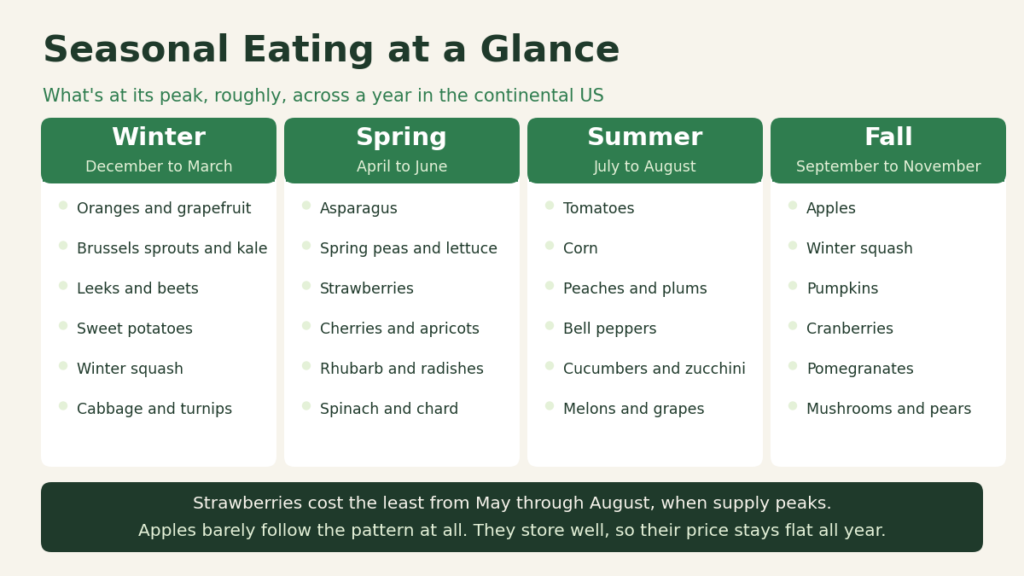
Use this as the rough shape of a year in the continental US. Shift it earlier in the South or California, later in the North.
January to March: citrus and sturdy greens
January belongs to citrus. Oranges, tangerines, grapefruit, and lemons are the one thing in the store in deep winter that’s genuinely at peak. Around them: brussels sprouts, kale, leeks, beets, sweet potatoes, and winter squash.
February runs the same cast, plus cabbage, turnips, parsnips, rutabagas, and kiwifruit. It’s soup and roasting pan territory, and it’s cheap.
March is the turn. Spinach, swiss chard, and collard greens wake back up. Radishes and artichokes start showing. Citrus is still around and worth buying.
April to June: the green months
April is asparagus, and asparagus in April is a different vegetable than asparagus in November. Also spring peas, lettuce, rhubarb, radishes, and the first strawberries in warm regions.
May is strawberries properly. Asparagus holds on, apricots arrive, cherries start, and lettuce is at its most tender before the heat turns it bitter.
June hands off to summer. Cherries, apricots, blueberries, zucchini, summer squash, okra, and swiss chard. Zucchini becomes a running joke for a reason.
July to September: the loud months
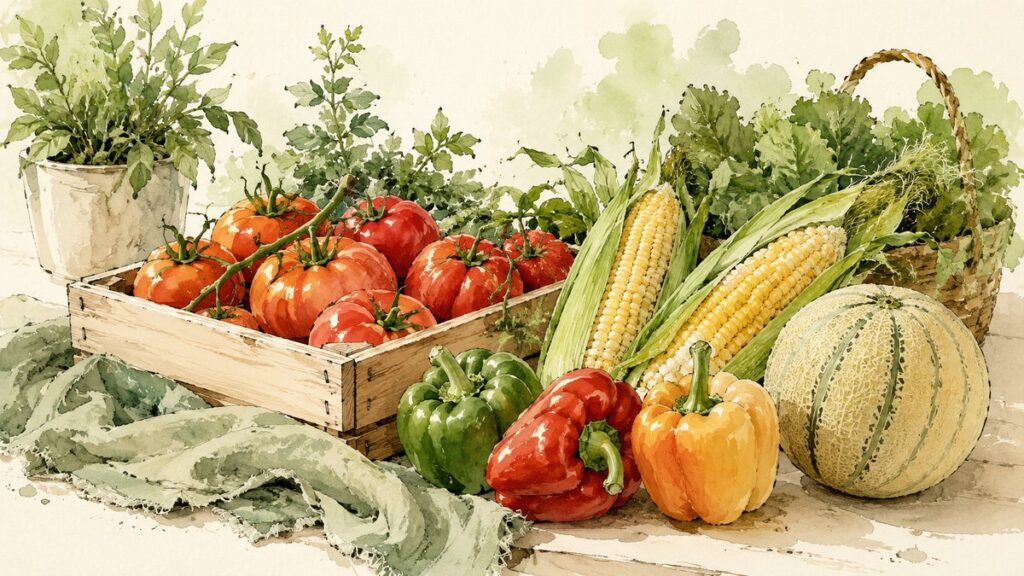
July is tomatoes and corn, and this is the month that converts people. A July tomato and a January tomato share a name and almost nothing else. Add peaches, bell peppers, blackberries, and melons.
August is the peak of the whole year. Corn, tomatoes, cucumbers, eggplant, green beans, peppers, peaches, plums, grapes, watermelon. If you shop seasonally one month a year, make it this one.
September is the handoff. Tomatoes hang on while pomegranates, mushrooms, pumpkins, cauliflower, grapes, and the first apples move in.
October to December: roots, squash, and citrus again
October is apples and winter squash. Acorn, butternut, delicata. Brussels sprouts get good, cranberries arrive, parsnips and lettuce come back around.
November is cranberries, sweet potatoes, winter squash, brussels sprouts, pears, and leeks. The holiday table is basically a seasonal menu already.
December closes the loop. Citrus comes back, along with kale, cabbage, potatoes, pears, and squash. Then January arrives and you start again.
For a searchable version by crop, the USDA keeps a free Seasonal Produce Guide that’s worth a bookmark.
Why in season produce tastes better and costs less
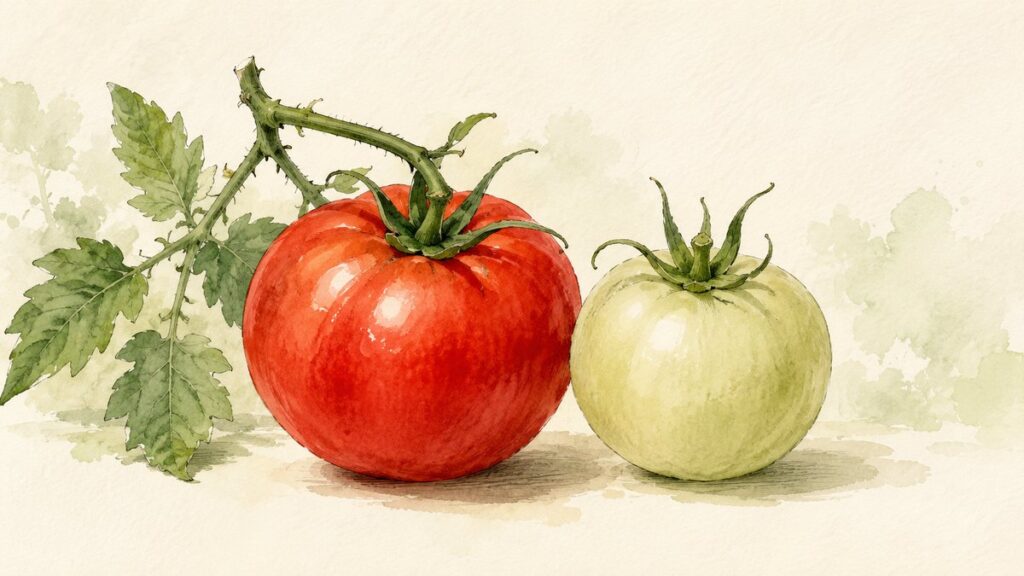
Two things are going on, and neither is mystical. The first is ripeness. Fruit headed across the country has to be picked firm enough to survive the trip, so picked ripe or picked for the truck is a real tradeoff, and flavor is what pays for it. Sugars and aroma mostly develop on the plant. They don’t catch up in a warehouse.
The second is supply. When a crop is everywhere at once, price falls. USDA economists have tracked this closely with strawberries: grower prices drift down through the first months of the year, then sit at their lowest from May through August when volume peaks, then climb again from September through December.
Here’s the honest part nobody puts on the poster: it doesn’t work the same for everything. Apples barely follow the pattern at all, because storage technology got good enough to release them evenly all year, so their price stays fairly flat. Seasonality is a strong signal for delicate crops and a weak one for storage crops.
Does seasonal produce have more nutrients?
A little, sometimes, and the reason isn’t the season itself. It’s the clock.
Once a vegetable is cut, it starts spending down its own reserves. Vitamin C and folate are the fragile ones, and they fall off measurably over days of refrigerated storage. Leafy greens are the worst offenders because they have so much surface area. Meanwhile minerals like iron and calcium hold steady, because a mineral doesn’t degrade in a crisper drawer.
So a local in season vegetable you eat within a couple of days usually beats one that spent a week in transit. It’s a modest edge though, not a different food group, and never a reason to skip vegetables in February. The same logic is why microgreens are so nutrient dense when you cut them yourself, and why how you store greens matters as much as where you bought them.
Frozen also deserves better than its reputation. Frozen produce is picked at peak and frozen within hours, which locks in the nutrients fresh produce loses on the road. Frozen spinach in January is often the better buy.
What a seasonal week actually looks like
Here’s the difference in practice, using two real weeks from our own kitchen in Elk Grove.
In August, the shopping is almost lazy. A flat of tomatoes, corn, peppers, a melon. Dinner is tomatoes with salt and olive oil, corn on the grill, whatever protein is around. Nothing gets cooked hard because nothing needs help, and the week costs less than usual.
In February, the same trip works just as well. Oranges, a head of cabbage, sweet potatoes, a couple of leeks, a bag of frozen peas. Roasted sweet potatoes and cabbage on a sheet pan twice, a pot of leek and potato soup, oranges for the four o’clock sugar craving. Not one strawberry in sight, and nobody misses them.
You’re not eating less well in winter. You’re eating a different list.

The one thing that’s in season every month
February is where any seasonal eating guide gets discouraging, so this is worth knowing. The freshest greens you can get in the dead of winter aren’t at the store at all. They’re on your counter.
Microgreens go from seed to harvest in about 10 to 14 days in a tray on a windowsill, in any month, in any climate, and you cut them minutes before you eat them. In January, a handful of fresh microgreens on a bowl of soup is the closest thing to a summer tomato that winter allows. The full growing guide covers a tray start to finish.
Common mistakes to avoid
- Treating it as a rule. This is a default, not a diet. Buy the out of season lemon. It’s a lemon.
- Trusting the sign. A “fresh, local” chalkboard is marketing, not a certification. Ask where it came from. At a real farmers market the answer is instant and specific.
- Buying the whole market. Peak season is intoxicating and then you compost half of it on Sunday. Buy for the meals you’ll actually cook this week.
- Refusing frozen. There’s a snobbery about it that costs people nutrition and money for no reason.
- Using someone else’s calendar. A list written for New England will lie to you in Georgia. Let your own market correct it.
Key takeaways
- Seasonal eating just means buying produce during its local harvest window. It’s a default, not a rule.
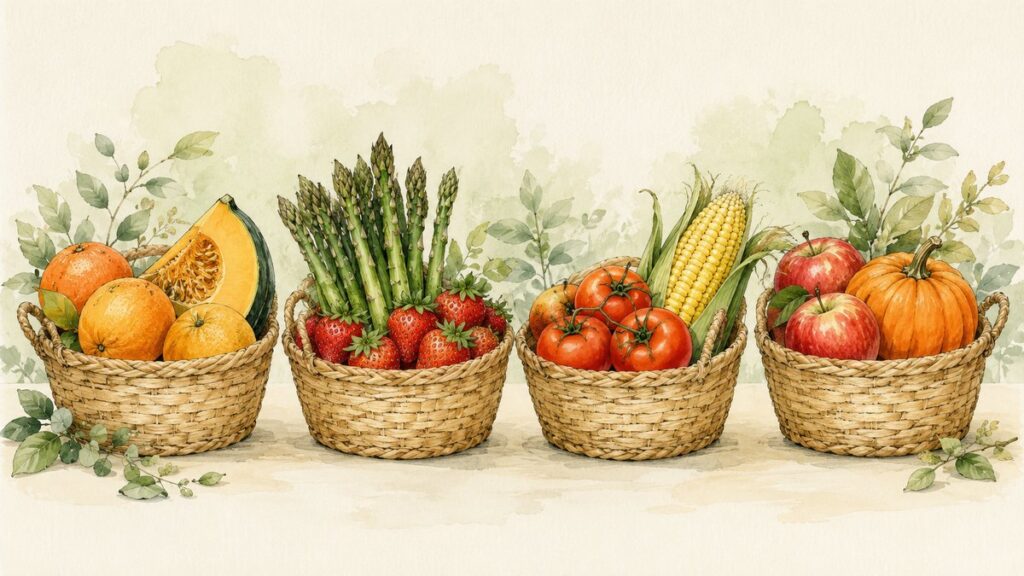
- Winter is citrus and roots, spring is greens and asparagus, summer is tomatoes and stone fruit, fall is apples and squash.
- In season produce tastes better because it was picked ripe, and it usually costs less because supply is high.
- The nutrition edge is real but modest, and it comes from time since harvest, not the season itself.
- Frozen is picked and frozen at peak, so it’s a genuinely good winter option.
- Microgreens are the one crop that’s in season every month, because you grow them where you eat them.
Frequently asked questions
Is seasonal produce actually cheaper?
For most crops, yes. When supply peaks, prices fall, which is why strawberries are cheapest from roughly May through August. Storage crops like apples are the exception, since they’re released to market evenly all year and their price barely moves.
Does eating seasonally mean eating only local?
No, though they overlap a lot. Something can be in season in California, get shipped to Ohio, and still be excellent, because it was picked ripe rather than green. Local just shortens the clock further.
Is frozen produce as good as fresh?
Often, and sometimes better. Frozen vegetables are processed within hours of harvest, so they keep the fragile nutrients fresh produce sheds during shipping. In winter, frozen usually wins.
How do I find out what’s in season where I live?
Check the USDA’s produce guide for the general picture, then walk your nearest farmers market and see what’s piled high and cheap. Abundance is the tell.
What if I can’t get to a farmers market?
A regular grocery store still follows the seasons, you just read prices instead of signs. When something is suddenly stacked in a big display and costs noticeably less than last month, it’s in season.
Where to go next
Treat this seasonal eating guide as a default setting rather than a project. If you’re building a produce habit from scratch, start with the easy ways to eat more vegetables. If you’re eating for inflammation, the anti inflammatory foods list lines up with this calendar more than you’d expect.
This article is general information, not medical advice. If you have a health condition, take medication, or are pregnant or nursing, please check with a qualified professional before making significant changes to how you eat.